
Think of an igneous rock as a mineral smoothie that Earth forgot to blend. Every igneous rock is a collection of tiny crystals, each one a different mineral that decided to show up to the party. The most common ingredients are silica (glass-making sand), feldspar (a grumpy cousin of clay), and olivine (which sounds like a fancy olive oil, but is actually a green crystal).
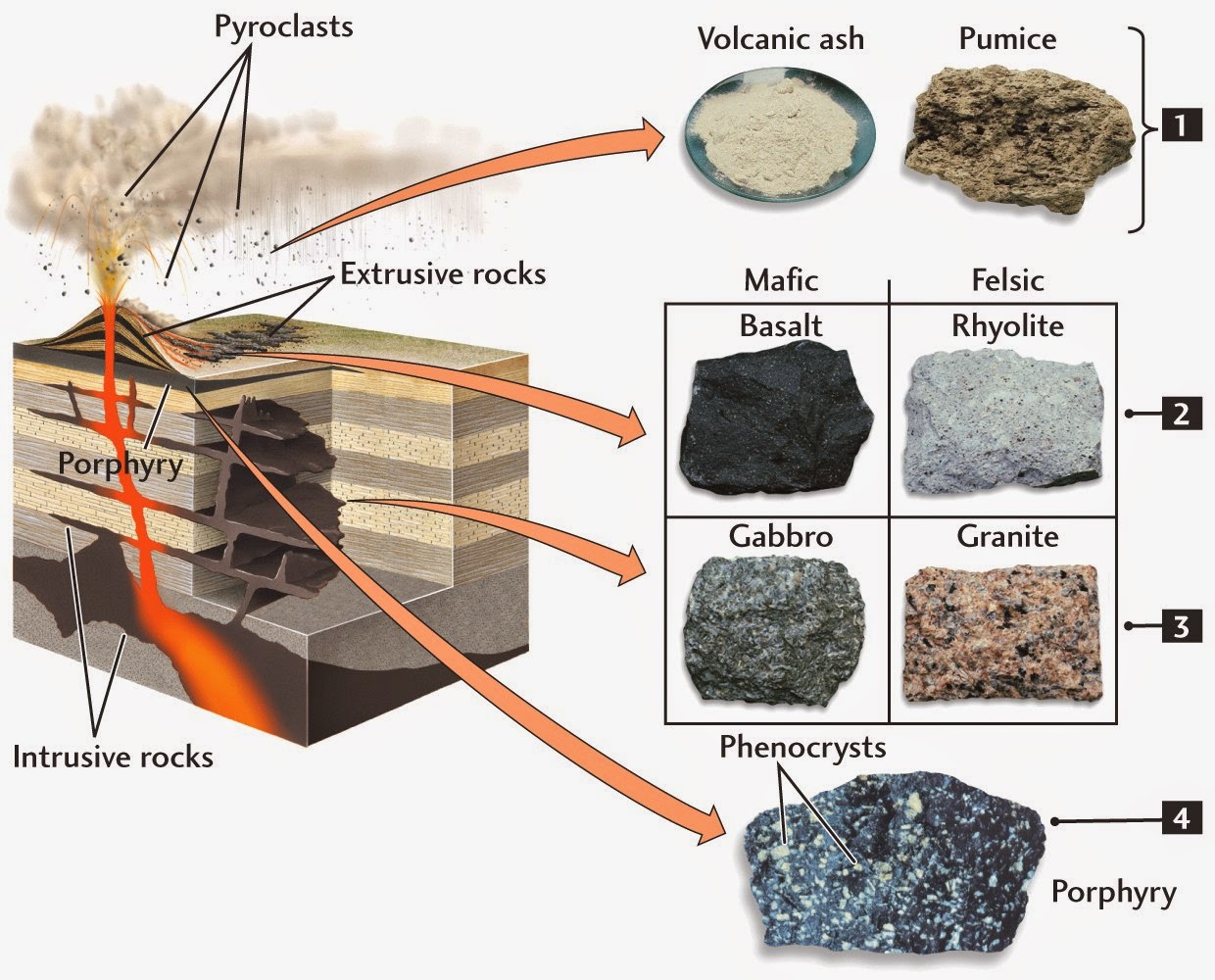
Here’s the wild part: the speed at which magma cools decides the size of those crystals. If magma cools super fast—like, thrown-into-a-snowbank fast—you get no crystals at all. That’s obsidian, a black glass so sharp that ancient people used it for arrowheads. If magma cools glacially slow, deep underground, you get chunky crystals you can see with your naked eye. That’s granite, the rock that makes kitchen counters look fancy.
The Two Big Teams: Intrusive vs. Extrusive
Geologists love putting rocks into two categories, probably so they can feel superior at cocktail parties. Intrusive igneous rocks form when magma gets trapped underground like a teenager in their room. It cools slowly, making big, visible crystals. Extrusive igneous rocks form when lava explodes onto the surface—think of it as the rock equivalent of a dramatic stage exit.
Take pumice, for example. That’s the bubbly, hole-ridden rock that floats in your aunt’s bathroom for scrubbing dead skin off her heels. Pumice is so full of gas bubbles from explosive lava that it’s actually lighter than water. You can toss a rock into a lake and watch it float. That’s not magic; that’s igneous geology showing off.
 The Texture of Igneous Rocks

